
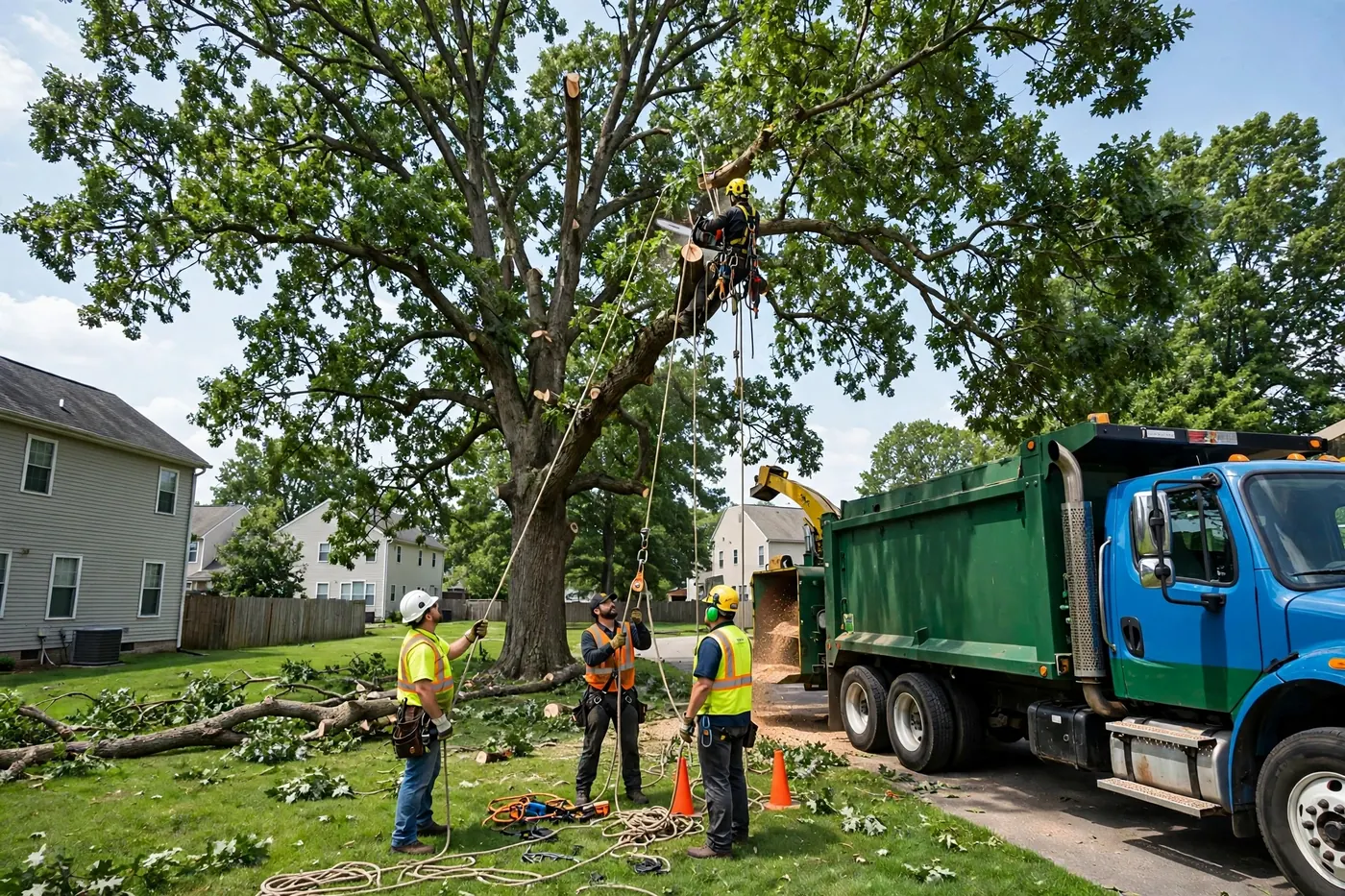
That big oak leans toward your roof. Every storm, you watch it. Is it fine — or is it going to come down? A tree risk assessment answers that question with facts instead of fear. We inspect the tree from roots to top. We look for cracks, rot, weak forks, and root damage. We check what the tree could hit if it failed. Then we give you a written verdict in plain English: the tree is safe, it needs work, or it should come down. Call or text (240) 213-4913 to set up your assessment.
What Is a Tree Risk Assessment?
A risk assessment is a formal evaluation of one question: how likely is this tree to fail, and what would it damage? It is not a guess. It follows a method used across the tree industry.
Three parts make up the risk. First, the likelihood of failure — is the trunk cracked? Are the roots rotted? Is a big limb hanging on by a thread? Second, the target — what sits underneath? A bedroom, a driveway, a play set, or just open lawn. Third, the consequence — how bad would it be if the tree or limb fell?
Put those together and you get a risk rating: low, moderate, high, or extreme. A cracked limb over your kid's swing set is high risk. The same limb over an empty back corner is low risk. The tree is the same. The risk is not.
This is different from a tree health inspection. A health inspection looks for disease and pests — what is making the tree sick. A risk assessment looks at structure — what could break. A tree can be healthy and still be high risk (a big lean over your roof). A tree can be sick and low risk (a dying tree in the back woods). You get a written report with our rating and a clear recommendation: monitor it, fix it, or remove it.
When You Need It
- A large tree leans toward your house and storm season is coming.
- You just bought a home with huge old trees and no history on them.
- A tree took a lightning strike or lost big limbs in a storm.
- Your insurance company flagged a tree on your property.
- A big tree stands over the play set or the driveway.
- You are deciding between pruning, cabling, or removing a tree.
- A neighbor's tree leans over your yard and you want facts before you talk to them.
How It Works
- Free on-site visit. We start by listening. What worries you? Has the tree changed? Did something happen in a storm? Your observations matter — you see the tree every day.
- Ground-level inspection. We check the root flare where the trunk meets the soil. We look for heaving soil, which means roots are lifting. We look for mushrooms at the base, which signal root rot. We check for construction damage — grade changes, trenches, or driveways that cut the roots.
- Trunk inspection. We look for cracks, especially vertical cracks that run with the grain. We tap the trunk to listen for hollow spots. We check old wounds, cavities, and places where bark is missing. A cavity is not always a death sentence — it depends on how much solid wood is left around it.
- Canopy inspection. We study the top of the tree. Dead branches in the upper canopy — a dead top — are a red flag. We look for weak forks where two big limbs meet in a tight V. We look for limbs that cross and rub, and for old storm damage that never healed right. Heavy lean gets measured against the trunk's strength.
- You get a written report. This is the part that makes it an assessment, not just an opinion. The report lists what we found, the risk rating for each tree, and our recommendation in plain words. Keep it for your records, your insurance company, or your peace of mind.
- We quote any recommended work. If the fix is pruning out weak limbs, adding cables, or removing the tree, you get a written price. Your call on what to do next. The assessment stands on its own either way.
What Affects the Cost?
Four things shape the cost of a risk assessment.
How many trees. One worried-about oak is a quick visit. A full property review of six or eight big trees takes real time. Most people start with the one or two trees that keep them up at night.
How formal the report needs to be. The first visit and our verbal read are free. A simple written summary of findings and recommendations is quoted up front. A formal documented report — the kind an insurance company or an HOA asks for — takes more time to write and costs more.
How hard the tree is to inspect. Most assessments happen from the ground with binoculars and hand tools. A tall tree with problems high in the canopy may need a closer look. If we need to get up there, we will tell you why and what it adds.
How fast you need it. A routine assessment gets scheduled in our normal rotation. If your insurance gave you a deadline, or a storm just damaged the tree and you need answers now, we move you up. Rush visits may cost more.
Whatever you need, the first visit is free, and you always see the price for the report before we write it.
Why Not Do It Yourself?
You can learn the warning signs. Big cracks. Mushrooms at the base. Soil heaving up around the trunk. A tree that leans more every year. Every homeowner should know those. But spotting a sign and judging the risk are two different skills.
A crack in the bark can be surface-level and harmless — or it can run deep into the wood. A leaning tree can be perfectly stable, anchored by roots that grew to hold it. A straight tree can be ready to fall, rotted hollow inside where you cannot see. The difference takes a trained eye and a lot of trees seen.
There is also a conflict-of-interest trap. If the only person who looks at your tree is a company that sells removals, guess what they recommend? An assessment from a crew that also does pruning and cabling gives you real options. Sometimes the honest answer is "this tree is fine." We would rather tell you that than sell you work you do not need. That is what the written report is for — it holds us to the facts. Call (240) 213-4913 for an honest read.
Common Tree Risk Assessment Mistakes
Mistake 1: Treating every lean as an emergency. Some trees lean their whole lives and never fall. A lean matters when it is new, getting worse, or paired with other signs like cracked soil or root damage. Panicking over a stable lean wastes money. An assessment tells you which leans matter.
Mistake 2: Asking only a removal company. A company that only removes trees has one answer for every risky tree: remove it. But pruning out the weak limbs or adding support cables can drop the risk enough to save a good tree — for less money. Get the assessment first, from someone who offers all the options.
Mistake 3: Waiting until storm season. Everyone wants assessments in August when the hurricanes come. By then the schedule is full and the risky tree is still standing. The smart time is late winter or spring — we find the problems, and there is time to fix them before the big winds.
Mistake 4: Ignoring the ground. People stare at the canopy and miss the base. Mushrooms growing from the roots. Soil lifted in a ring around the trunk. A trunk that moves in the wind while the roots stay put. Root failure drops whole trees, and the signs are all at ground level. Look down, not just up.
Our Service Area
Waldorf Tree Services Experts performs risk assessments across Waldorf, MD and all of Charles County — including La Plata, White Plains, and Accokeek. If a big tree near your home has you worried, we will come look and give you the facts. See our tree service in La Plata and tree service in Accokeek pages for nearby coverage.
Get a Free Estimate
Ready when you are. Call or text (240) 213-4913 — or send our short form and we will call you back. One call. Free visit. Written price. No pressure.
[Call (240) 213-4913 — tap to call: tel:+12402134913]
Free estimate form: Name | Phone | Service needed
Waldorf Tree Services Experts — we serve Waldorf, MD and all of Charles County.